Winning in Life with Game Theory: Lessons from Tit-for-Tat

Many people believe in the saying “Nice guys finish last”—that good people will always lose to those who are cunning. However, does science support this claim? We will dissect Game Theory to find the best strategy for dealing with complex human interactions.
1. Prisoner’s Dilemma
The foundation of this theory is a classic scenario: You and your friend are caught by the police. If both of you stay silent (cooperate), you only get 1 year in prison. However, if you betray your friend while they stay silent, you go free and they get 20 years. If both betray each other, both get 5 years.
From an individual logic perspective, betraying seems safer. However, the collective outcome is worse. This is the dilemma we often face in investment, business, and even international relations.
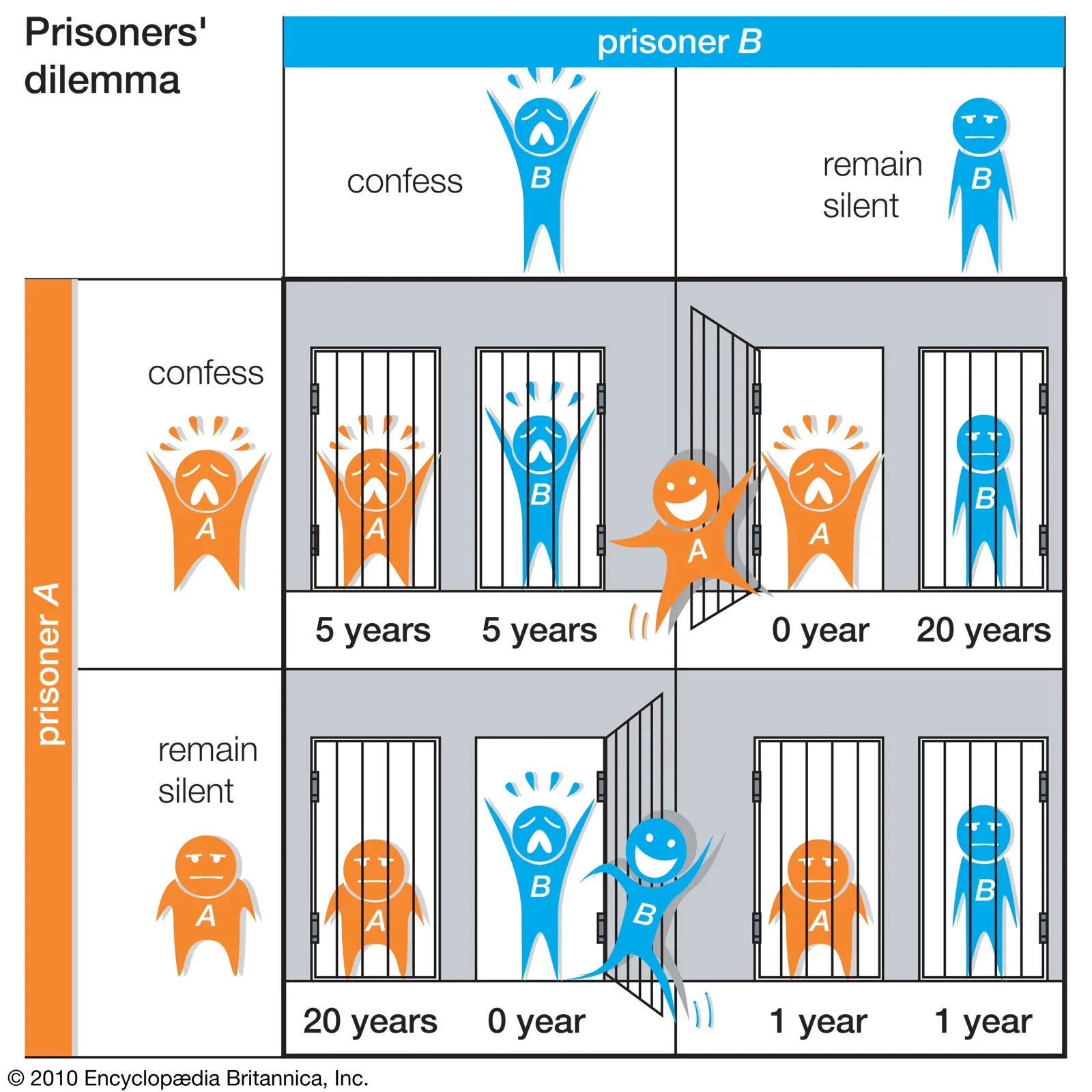
Prisoner's Dilemma
2. Robert Axelrod’s Tournament: Finding the Champion Strategy
A political scientist named Robert Axelrod held a competition where various computer programs (strategies) fought each other in 200 rounds. Some were very evil (always betraying), some were very forgiving, and some were random.
The result was surprising: The winning strategy wasn’t the most cunning one, but rather the simplest one called Tit-for-Tat.
How Tit-for-Tat Works:
- Start with cooperation (be a good person).
- Mirror the opponent’s move: If the opponent is good, stay good. If the opponent betrays, retaliate immediately in the next round.

Tit for Tat in card game
3. Four Qualities of “Winners” in Life
Based on the experiment, strategies that performed best always had four main qualities:
- Be Nice: Never betray first. “Evil” strategies might win early, but they crumble in the long run because no one wants to cooperate with them anymore.
- Forgiving: If an opponent who was previously evil becomes good again, Tit-for-Tat will forgive and cooperate again, rather than holding a grudge forever.
- Retaliatory: Don’t let yourself be trampled on. If betrayed, you must give a firm response so you’re not seen as weak or easily exploited.
- Clear Communication: Your strategy must be easy for others to understand. Unclear or random behavior triggers suspicion and attacks from others.
4. Important Lesson: Dealing with “Noise” (Misunderstandings)
The real world is full of noise or misunderstandings. We often have good intentions, but are perceived as evil by others. In simulations containing noise, pure Tit-for-Tat can get trapped in an endless spiral of revenge.
The solution? Generous Tit-for-Tat. This strategy adds about 10% extra forgiveness. Sometimes, even though we are “attacked,” we choose to stay silent once to break the chain of conflict.
5. Conclusion: Winning Battles vs Winning Wars
The most mind-blowing thing is: Tit-for-Tat actually never “wins” in one-on-one duels. It can only tie or lose narrowly. However, because it’s very good at cooperating with many parties, its total score at the end of the tournament is always the highest.
In life, we often obsess over wanting to “win” when arguing with our partner or coworker. However, it’s often better to “lose” in one small argument (battle) to win the long-term relationship (war).
Comments & Discussion