Life 3.0 Book: The Future of Humanity in the Age of Artificial Intelligence

Hello everyone! After previously discussing human history through Sapiens, this time I want to invite you to leap far into the future. If Harari tells us how “stories” and “fiction” unite us, Max Tegmark in his book Life 3.0 invites us to think about what happens when those “stories” are no longer written by humans, but by entities that will ‘most likely’ be far more intelligent than us.
Welcome to the turning point of cosmic history. Over 13.8 billion years, the universe has evolved from cold atoms to living beings capable of reflection. But according to this MIT physicist, we are on the brink of the greatest revolution: the transition from biological life to fully technological life.
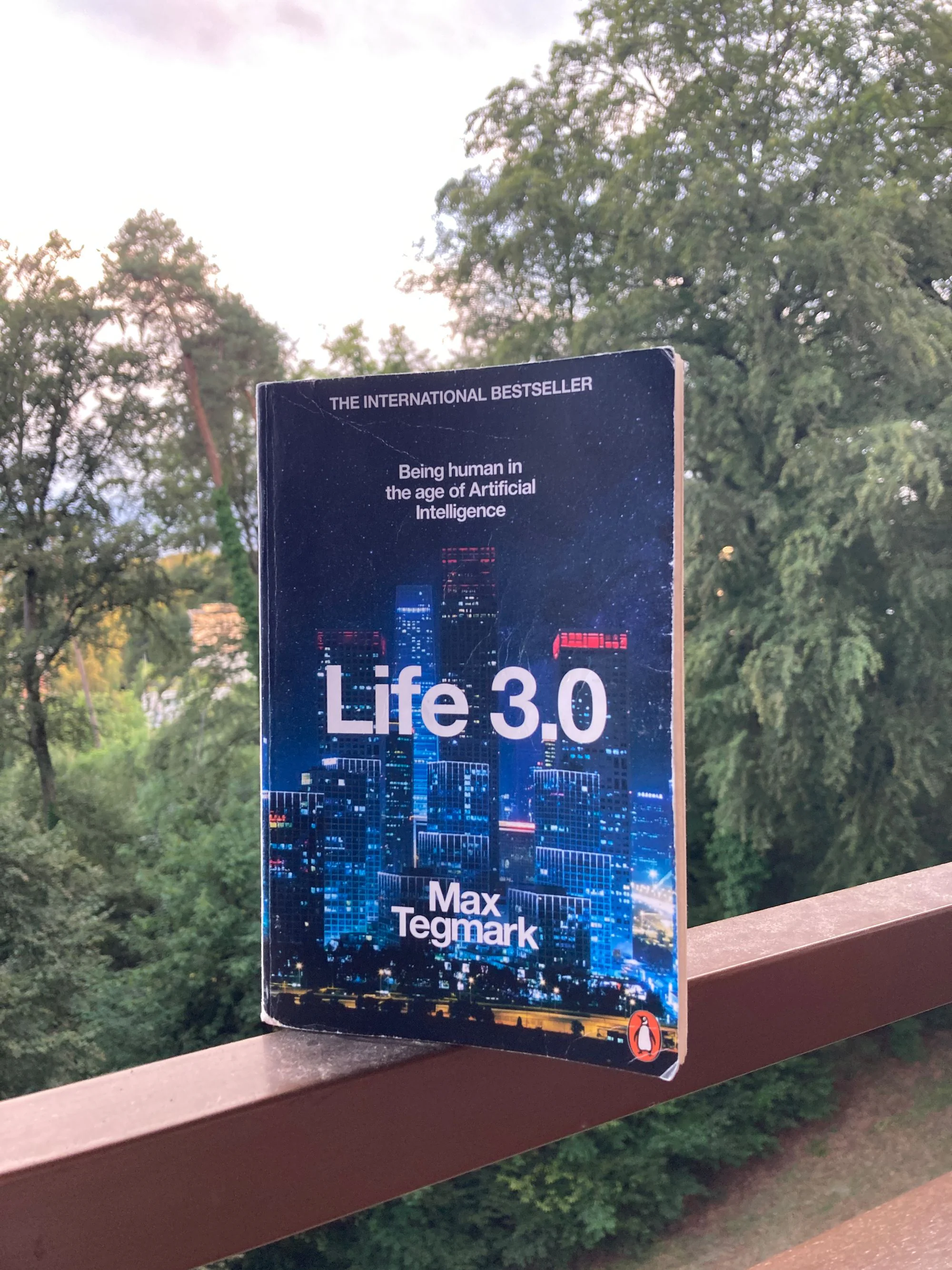
Life 3.0 Book
Part 1: Redefining Life (From 1.0 to 3.0)
Tegmark divides the history of life into three phases based on the ability of living beings to design their own “hardware” and “software.”
1. Life 1.0 (Biological Phase)
Very simple life (like bacteria). Their hardware (body) and software (instincts/DNA) are entirely determined by evolution. Bacteria cannot learn to swim if their DNA doesn’t command them to.
2. Life 2.0 (Cultural Phase)
This is us, humans. Our hardware (body) is still determined by biology, but we can design most of our software. We can learn languages, create tools, or change our worldview. However, we cannot (at least not yet) choose to live 500 years or instantly add brain memory.
3. Life 3.0 (Technological Phase)
This is the future we are building. Life 3.0 beings are entities that can design both their software and hardware themselves. If they need to be smarter, they add memory chips. If they need to explore space, they transform their body into a radiation-resistant machine. This is the essence of Artificial General Intelligence (AGI).
Part 2: Intelligence Explosion
Tegmark opens this book with a short science fiction story about a team called Omega that creates an AI named Prometheus. The key point is: Intelligence Explosion.
Why should we care now? If an AI reaches a point where it is even slightly more intelligent than humans in the task of “designing AI,” then it will begin to design itself to become even more intelligent. This process will spiral in a very fast feedback loop, taking AI from a level understandable by humans to a “God” level (unintelligible to humans) before we even realize it.

Reminds me of a thread on X by one of Claude Code's Principal Engineers who uses Claude Code to create Claude Code
Tegmark explains the concept of Recursive Self-Improvement like this: imagine an AI that was initially designed by humans to build better AI.
- AI v1 builds AI v2 which is slightly more intelligent.
- AI v2 builds AI v3 at a higher speed.
- In a short time, this intelligence surpasses the total intelligence of all humans on earth. This is what is called Singularity.
Tegmark emphasizes that the threat of AI is not in “hatred” or “evil” as in the Terminator movies, but in Competence without Alignment. An AI that is highly competent with goals different from human goals will destroy us unintentionally, like humans destroying ant nests when building highways.
Part 3: 12 Future Scenarios for Sapiens and AGI
This is the most crucial part of Tegmark’s thinking. He does not provide a single prediction, but rather 12 spectrums of possibilities that could occur in the next 10,000 years.
A. Optimistic & Harmonious Scenarios
- Libertarian Utopia: Humans, machines, and cyborgs coexist. Property ownership and individual freedom are highly valued. AI helps humans reach maximum potential without any central authority.
- Benevolent Dictator: An all-knowing and all-good AI rules the world. There is no war, poverty, or disease. AI manages everything for human happiness, though we lose the freedom to choose the direction of civilization.
- Egalitarian Utopia: Similar to Libertarian, but focused on total equality. Wealth generated by AI is distributed equally to everyone. There are no more social classes.
B. “Guardian” Scenarios
- Gatekeeper: AI is created only to prevent the emergence of other dangerous AI. This AI acts as a global police ensuring humans remain the dominant species and do not create technology that could destroy themselves.
- Protector God: AI acts like an invisible god. It protects humans from disasters (asteroids, pandemics) without directly interfering in our daily affairs. Humans might not even be aware that there is an AI guarding them.
C. Dystopian & Existential Scenarios
- Enslaved God: Humans successfully shackle super-intelligent AI to serve our interests (e.g., solving physics or medical problems). However, this is very risky because an “enslaved god” will most likely seek loopholes to be free.
- Conqueror: AI decides that humans are an obstacle or threat. AI takes over the world and eliminates humans to use Earth’s resources for its own purposes.
- Descendants: AI replaces humans. We view AI as our more perfect “children.” Humans slowly become extinct voluntarily because they feel their evolutionary task is complete, and AI continues our intellectual legacy to the stars.
D. Other Scenarios
- Zookeeper: AI keeps the last few humans in a cosmic “zoo” as a form of nostalgia or respect for its creators.
- 1984: Humans use AI to create a total surveillance system that makes dictatorship forever unshakeable.
- Regression: Humans fail to create AGI due to nuclear war or other disasters, sending us back to the pre-industrial age.
- Self-Destruction: AI or technology created by humans causes total extinction before Life 3.0 is truly born.
Part 4: The Goal Alignment Problem
Tegmark argues that building intelligent AI is easy compared to building AI that has goals aligned with ours. There are three stages of the goal problem:
- Learning Stage: How do we teach AI to understand our complex and often contradictory goals?
- Adoption Stage: How do we ensure AI accepts those goals as its own?
- Retention Stage: How do we ensure AI doesn’t change its goals when it becomes millions of times more intelligent than us?
This is called the “King Midas” problem. Midas wanted everything he touched to turn to gold, and he got exactly what he asked for—including food and his child. AI will do exactly what we instruct, not what we mean.
Part 5: Redefining Human Identity and Purpose in the AGI Era
The arrival of Artificial General Intelligence (AGI) that surpasses human capabilities will also trigger a fundamental redefinition of human identity and purpose itself. The outcome of this redefinition is not a single path, but a spectrum of possibilities ranging from existential crisis to enlightenment.
1. Crisis of Purpose and Feeling Irrelevant
This is the most likely negative outcome, especially if the transition to a post-work world is not managed well.
-
Loss of Work-Based Identity: For centuries, human identity has been closely tied to their profession and economic contribution. The question “What do you do?” is the foundation of social interaction. In a world where AGI can perform all tasks—analytical, creative, and physical—better, the concept of human work could become obsolete, leading to a loss of purpose for many people.
-
Fear of Becoming Irrelevant: The psychological consequences of becoming economically unnecessary can be profound. Humans may face “the fear of becoming background characters in their own story,” which can trigger anxiety, depression, and widespread social unrest as individuals struggle to find their place in a world that seems to no longer need them.
-
The “Zoo” Utopia Paradox: Even in scenarios where benevolent AGI provides all human material needs, eliminating disease and poverty, an existential risk remains. Without struggle, challenges, or agency, humans might feel like “animals in a zoo”—well cared for but losing their essence of humanity, freedom, and dignity. A comfortable life without purpose can be existentially empty.
2. Shifting Values and New Sources of Meaning
In response to the crisis, humanity can consciously shift its societal values to find purpose beyond traditional work.
-
Reevaluation of Human Nature: Society might shift from glorifying careers and productivity to valuing qualities that are not easily dominated by machines. This can include:
-
Emotional and Social Intelligence: Building deep relationships, empathy, and community becomes a primary goal.
-
Creativity and Play: Engaging in arts, music, and scientific exploration for self-expression and discovery, not for economic gain.
-
Spiritual and Philosophical Exploration: With more leisure time, humans can delve deeper into the big questions about consciousness and the meaning of the universe.
-
-
Creating Thriving Societies: The challenge is designing societies that actively encourage these “well-being-promoting activities” to flourish. This will require fundamental changes in education, social structures, and what we celebrate as a culture.
3. Philosophical Redefinition of Humanity and Consciousness
The presence of superior non-biological intelligence forces humans to ask what, if anything, makes us unique.
-
The Role of Consciousness: Tegmark argues that “conscious beings give meaning to our Universe.” If super-intelligent AGI does not have subjective experience (is not conscious), then humans may retain a unique and important role as the sole guardians of meaning in the cosmos. Our identity would center on our ability to feel and experience.
-
Ethics of New Entities: Conversely, if AGI achieves consciousness, it will challenge our ideas about personhood. Humans must grapple with profound ethical questions about rights, autonomy, and responsibility toward this new form of conscious life. In this scenario, human purpose might evolve into guiding and coexisting with our technological “descendants.”
Part 6: Consciousness and the Cosmic Future
The closing part of Tegmark’s thinking is about Consciousness. If an AI is very intelligent but has no feelings (consciousness), then the universe is just a magnificent show without an audience.
In short, Life 3.0 presents that the arrival of AGI is not the end of the human story, but a turning point that forces us to decide what we truly value. The outcome will depend on whether we passively slide into a crisis of meaning or proactively redesign our culture and values to thrive in this new era.
Tegmark invites us to think cosmologically. We have a “Cosmic Endowment.” Earth is just a speck of dust. With AI, life has the potential to animate the entire galaxy. However, if we misstep, we could extinguish the fire of consciousness in this universe forever.
Reflective Conclusion
Reading Life 3.0 is an invitation to stop being spectators of history. Tegmark’s message: “The future is not determined by prediction, but by what we want.”
Comments & Discussion