PoC in SDLC: Why "Try First" Before a Big Build?

Hey everyone — Akmal here again. In engineering, some technical bets are expensive if you guess wrong — new library, new architecture, a migration. What you usually need isn’t a long opinion piece; it’s a small proof first.
That’s what a Proof of Concept (PoC) is for. Not a finished product, not a polished demo — a limited trial to answer: can this work? Useful for risky features in an existing app, and for architecture decisions on new products.

Difference between PoC, Prototype, and MVP
PoC, Prototype, MVP — What’s the Difference?
Proof of Concept (PoC) is an early demonstration or trial: proof that an idea, technology, or solution can work in a limited scenario before you develop it further.
In short: “Can this actually work?”
These three get mixed up a lot:
- PoC — validates concept/technology. “Can technology X do Y?”
- Prototype — validates design and UX. “Is this design easy to use?”
- MVP — validates in the market. “Will people pay?”
A PoC is usually the simplest version. It doesn’t need to look good, be complete, or be production-ready. What matters: the concept is proven.
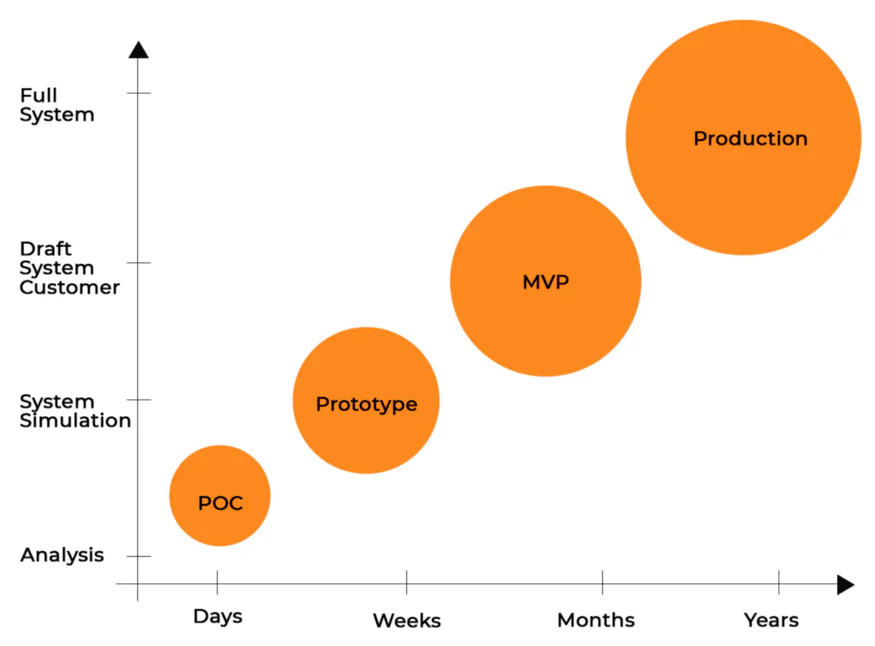
Starting from PoC, then prototype, MVP, then Product
Feature level vs product level
Feature-level PoC — one specific feature before integrating it into an existing app. For example: check whether a fuzzy search algorithm fits before wiring it into the current search feature.
Product-level PoC — technology or architecture for a new product or major change. For example: test whether microservices make sense for a monolith you’re planning to refactor.
Different context. Feature PoCs tend to be faster and narrower; product PoCs need more strategic thinking. Both are valid—just different scope.
PoC often runs on a developer’s laptop, without full production infrastructure. On purpose. If the concept isn’t feasible, you don’t waste time building expensive infra first.
Why PoC Matters in SDLC
Software Development Life Cycle (SDLC) — from idea to shipped product. PoC helps at several points:
Lower risk. Technical problems found in a PoC are much cheaper than after full integration. Say you want fuzzy search: without a PoC, you might spend two weeks integrating a library, then discover it’s too slow. With a PoC, you might know in two days the library isn’t a fit. At product level, same pattern—e.g. test serverless for a week instead of building for three months before cold start becomes a blocker.
Clearer decisions. Stakeholders often can’t choose between technology A and B. A PoC gives evidence, not slides or vendor promises. Compare two AI integration options with small PoCs—see which is easier and closer to your needs.
Problems show up early. Integration, performance, scalability—better to find them upfront.
Illustrative Examples
The scenarios below aren’t real company stories; the numbers are example criteria for a PoC.
Feature level
Real-time notifications (WebSocket) — say a chat app wants real-time notifications. PoC question: can WebSocket handle ~1000 simultaneous connections? Example criteria: latency under 50ms, memory under ~500MB, reconnect logic works. Pass → proceed with implementation. Fail → find an alternative before committing to the full stack.
Excel export — say a CRM app wants complex Excel exports. PoC: can the chosen library generate the right format in under 5 seconds for ~10,000 rows? If yes, the library is worth using. If not, switch library or approach.
Product level
Blockchain for transactions — say an e-commerce team considers blockchain for immutable transaction records. PoC handles one transaction type first. Common example criteria: data stores correctly, but write time is too slow for real-time, and per-transaction cost is too high for small purchases. Illustrative decision: blockchain only for large transactions that need a strong audit trail—not every transaction.
Cloud migration — say a legacy app is moving to the cloud. PoC: can a subset of workloads run in the cloud with minimal changes, with acceptable performance and operating cost? If results look good, phased migration beats a big bang.
When to use which?
Feature level — new feature on an existing app, technology/algorithms the team hasn’t used before, or high technical risk (performance, compatibility).
Product level — new product from scratch, major architecture change (monolith → microservices), or adopting tech that affects the whole system.

How PoC is implemented
Benefits, Challenges, and Common Traps
What you gain: less uncertainty—concrete evidence, not theory. Faster decisions. The team aligns on technical goals.
What to watch for:
- PoC is not a guarantee the final product succeeds. Scope is narrow, conditions are controlled.
- It still takes time and people—a PoC isn’t free.
- PoC assumptions are often simplified; results can be optimistic vs real production.
- The stakeholder expectation trap — PoC succeeds, then everyone assumes the finished product is copy-paste. It isn’t; PoC is deliberately minimal. Say that upfront.
Practical Tips
Clear goal. Before coding, write the question you’re answering. Example: “Can the Excel library generate complex formatting in < 5 seconds for 10,000 rows?”
Tight scope. One PoC, one (or two) questions. Don’t prove performance, UX, and compliance all at once.
Realistic data. Simplified is fine; too ideal isn’t—you’ll get misleading results.
Document it. Goal, method, results, conclusion. So the team (and future you, three months later) knows what was and wasn’t proven.
Evaluate honestly. A failed PoC is a valid outcome—it saves you a full build. Don’t force continuation just because you already invested time.
Closing
PoC in SDLC is a tool to reduce guessing before a big commit. Not magic, not a success guarantee—but a practical way to prove a concept first, then scale.
Next time you’re handed new tech or a high-risk feature: scope a small PoC, measure against clear criteria, document, and accept the result as-is. Better to fail in a two-day PoC than in three months of production work.
Comments & Discussion