Reflection on The Selfish Gene: We Are Merely "Hardware" for Genetic Code

After previously discussing Sapiens, there’s another book that fundamentally changed how I view life: The Selfish Gene by Richard Dawkins.
As someone who deals with lines of code every day, this book feels both very familiar and terrifying. Dawkins proposes a provocative thesis: The fundamental unit of evolution is not the individual, nor the species, but the gene.
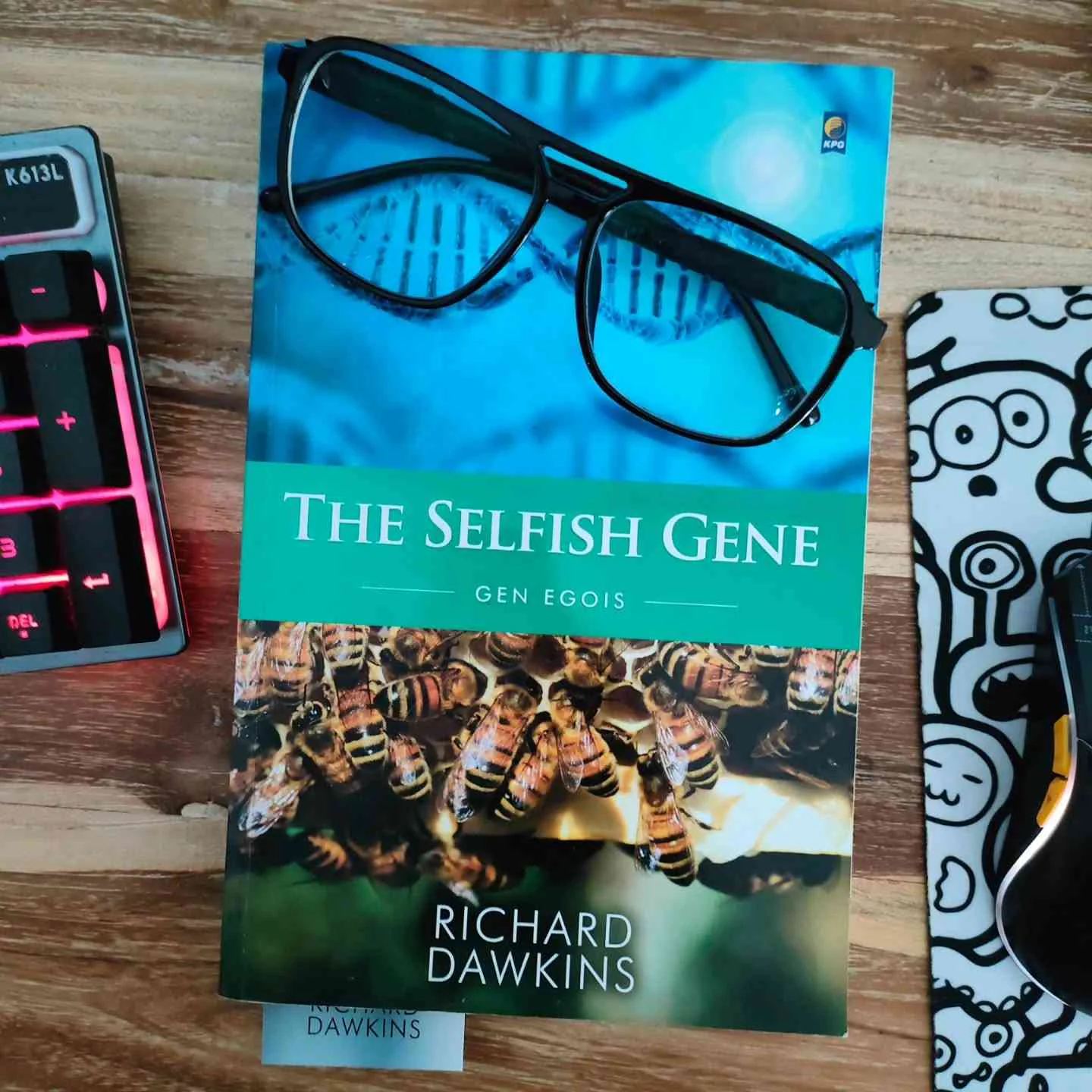
The Selfish Gene
1. Our Bodies Are Hardware, Genes Are Source Code
In the software world, we know that hardware will become obsolete and break down, but code can be copied and survive forever if transferred to new hardware. Dawkins argues that humans (and all living creatures) are merely “Survival Machines”—transport robots built by genes so they can continue replicating themselves from one generation to the next.
We often feel that we are the “captain” of our own bodies. However, Dawkins invites us to see from the gene’s perspective:
They are inside you and me; they created us, body and mind; and their preservation is the ultimate rationale for our existence.

Gene and DNA Structure
2. “Selfish” Altruism
One thing that stuck with me the most is Dawkins’ explanation of Altruism. Why do we help others, even to the point of sacrificing ourselves? Is it pure goodness?
Mathematically, Dawkins explains through the concept of Kin Selection. “Smart” genes will program their vehicles (us) to help other individuals who carry copies of the same genes (family/relatives).
If I sacrifice my life to save two of my siblings, statistically, my “code” remains safe because each of my siblings carries 50% of my genes. So, the noble behavior we call love can actually be explained as a calculative strategy by genes to ensure their replication continues.

Kin Selection
3. Memes: Evolution Beyond Biology
As a technology enthusiast, the most interesting part of this book is the final chapter where Dawkins introduces the term “Meme”. Before this word became synonymous with funny images on the internet, Dawkins defined Meme as a unit of cultural transmission.
Just as genes replicate themselves through sperm and eggs, Memes replicate themselves from brain to brain through language, writing, and now, the internet.
- Ideologies, songs, fashion styles, even programming algorithms are Memes.
- They compete for “space” in our brain’s memory.
This connects the dots from the Sapiens book. If Harari talks about “Imagined Orders”, Dawkins gives a name to the building blocks of that order: Memes.

4. Rebellion Against the Software (Genes)
Although this book sounds very deterministic and cold, Dawkins closes it with an extraordinary note of hope.
Humans are the only species on Earth with sufficient consciousness to rebel against the tyranny of these selfish replicators.
Consciousness as Life’s “Debugger”
In the programming world, we have debuggers that allow us to pause program execution, inspect variable states, and even change values mid-runtime. Human consciousness works in a similar way—we can “pause” our instincts, examine why we’re doing something, and decide not to follow the “default behavior” programmed by genes.
Concrete examples:
-
Contraception: Genes program us to reproduce as much as possible. But we can say “no” and choose not to have children, or delay reproduction to focus on career, education, or other life goals.
-
Diet and Exercise: Genes program us to hoard calories (a survival mechanism from times of famine). But we can ignore cravings for junk food and choose healthy foods, even when our bodies are “screaming” for sugar and fat.
-
Universal Altruism: Genes program us to help relatives (kin selection). But we can help strangers who have no blood relation at all—even sacrifice ourselves for people we don’t know, such as in cases of organ donation or heroic acts of saving others’ lives.
-
Ethics and Morality: Genes program us to compete and win resources. But we can build fair systems, give equal rights to everyone, even when it means we must sacrifice personal gain.
Philosophical Implications: Are We Truly Free?
This brings us to a deep philosophical question: If we are “vehicles” for genes, is our rebellion truly free? Or is this also part of a more complex program?
Dawkins doesn’t provide a definitive answer, but he emphasizes that our consciousness is a real phenomenon, regardless of its origins. Even if consciousness is a “bug” in the genetic system, or an “emergent property” that wasn’t planned, the fact that we can rebel makes us different from other gene vehicles.
Memes as Weapons of Rebellion
Even more interestingly, we don’t just rebel with individual consciousness—we also use Memes (ideas, culture, ethical systems) as weapons to fight against genetic tyranny. Religion, philosophy, law, and moral systems are “code” that we write ourselves to override genetic “code”.
When we choose to follow religious teachings that forbid adultery, or philosophy that advocates vegetarianism, or laws that require us to pay taxes to help the poor—we are running “programs” that are newer, written by culture, not by genes.
This is dual inheritance theory: We inherit two types of information—genetic (from DNA) and cultural (from memes). And sometimes, they conflict. When we choose memes over genes, we are rebelling.

Conclusion: Biological Humility
Reading The Selfish Gene made me more humble. We are not the center of the universe. We are not even the center of our own bodies. We are part of a digital-biological information flow that has been running for billions of years.
However, realizing that we are merely “vehicles” makes our moments of consciousness incredibly valuable. We are the only vehicles that can look back and ask the driver (genes): “Why are we going in this direction?”
Comments & Discussion